
Namibia travel · NamSpace
Driving in Namibia: The Practical Self-Drive Guide to Gravel Roads, Fuel, Distances & 4x4s
Choose a vehicle, plan fuel stops and leave enough time for gravel-road journeys.
As an Amazon Associate I earn from qualifying purchases. This article contains optional Amazon links. Check delivery and the full cost before buying.
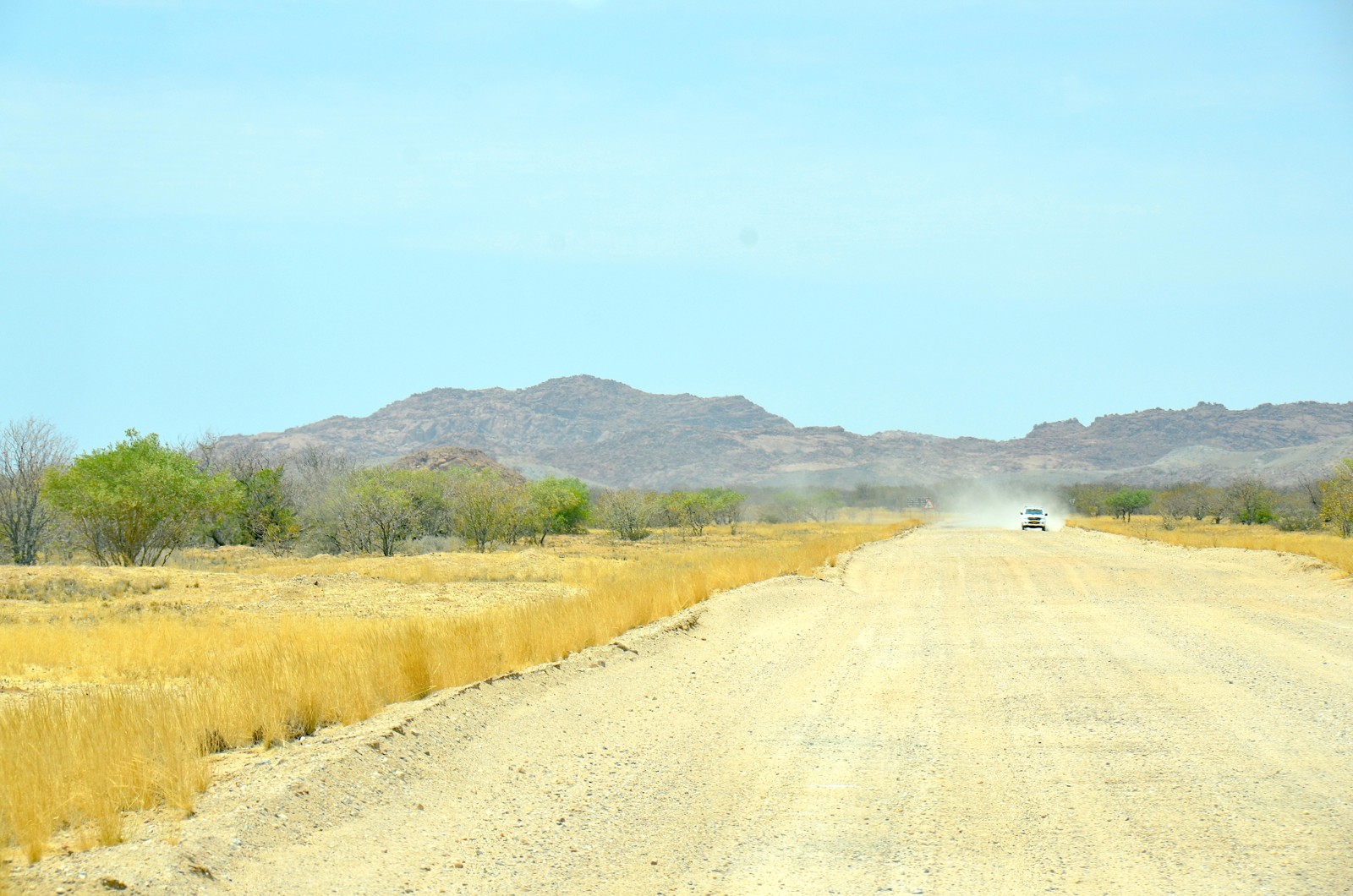
Image credit & rights
Gravel road, Namibia.jpg — Olga Ernst, via Wikimedia Commons. CC BY-SA 4.0. Source: https://commons.wikimedia.org/wiki/File:Gravel_road,_Namibia.jpg. Licence: https://creativecommons.org/licenses/by-sa/4.0/. Resized for web; no scene content changed.

Last checked: 4 October 2026
Namibia is one of the easiest countries in Africa to imagine as a road trip.
Long straight roads. Open landscapes. Very little traffic. A vehicle, a map and somewhere good to sleep at the end of the day.
And honestly, that is part of what makes travelling here so good.
But Namibia is also a country where a road that looks simple on Google Maps can take longer than expected, where the surface can change from tar to gravel, and where the difference between a comfortable drive and a bad day is often not the distance itself.
It is the speed you planned to drive it.
So this guide is not here to scare you away from self-driving.
It is here to help you do it properly.
Driving in Namibia at a glance
- Namibians drive on the left-hand side of the road.
- Most of Namibia's national road network is unsealed, not tarred.
- Namibia Tourism Board recommends not exceeding 80 km/h on gravel roads, even though the general legal limit outside urban areas can be higher where no lower sign is posted.
- The general legal speed limits are 60 km/h in urban areas, 100 km/h outside urban areas on unsealed roads and 120 km/h outside urban areas on tarred roads, unless a road sign sets a different limit.
- A 2WD can reach many major tourism destinations, including Swakopmund, Etosha and the main Sossusvlei route, but a high-clearance vehicle or 4x4 gives you more flexibility for rougher and more remote routes.
- If your foreign driving licence is not in English, Namibia's regulations require an English certificate of authenticity/validity or a sworn English translation; the licence should also contain or have attached a photograph and signature. International driving permits are recognised subject to the applicable rules.
- If you plan to take a rental vehicle across a national border, tell the rental company before leaving so the required paperwork can be arranged.
First, understand what a Namibian road trip actually looks like
The Roads Authority's current network information lists roughly 8,400 km of bitumen roads, compared with more than 40,000 km of gravel, earth and salt roads combined.
That is why Namibia can have very good road infrastructure and still require a different driving mindset from a country where almost every long-distance route is paved.
A gravel road is not automatically a bad road.
Many Namibian gravel roads are maintained and perfectly practical for tourism.
But they are not tar.
They can develop corrugations, loose gravel, soft shoulders, dust, washaways after rain and changing grip from one section to the next.
And that means your itinerary has to respect the road you are actually driving, not just the number of kilometres on the screen.
The most important speed rule: legal does not always mean sensible
Namibia's Road Traffic and Transport Regulations set the general speed limits, unless a lower limit is posted, at:
- 60 km/h on public roads within urban areas;
- 100 km/h outside urban areas on roads that are not tarred; and
- 120 km/h outside urban areas on tarred roads and freeways.
But that does not mean you should drive a gravel road at 100 km/h simply because the law allows it.
Namibia Tourism Board specifically recommends that travellers do not exceed 80 km/h on gravel roads.
And even 80 can be too fast for the conditions in front of you.
Rain, sand, corrugations, livestock, wildlife, blind rises, dust from another vehicle and a heavily loaded rental can all make a lower speed the sensible one.
Your rental agreement may also impose its own speed or road restrictions.
So the better rule is:
Drive for the road, not for the maximum number on the law book.
Why gravel catches first-time drivers out
Tar is predictable.
Gravel can change underneath you.
One section may feel smooth enough that you relax and gradually increase speed. Then the surface changes, the road bends, the tyres reach loose gravel and suddenly the vehicle feels much lighter than it did ten seconds earlier.
This is where overconfidence causes problems.
Give the steering wheel smaller inputs.
Slow down before the corner rather than braking aggressively halfway through it.
Leave more space behind other vehicles because dust can destroy your visibility.
And if another car approaches at speed, ease off rather than treating the road like a competition.
A cracked windscreen and a damaged tyre can come from something as simple as gravel thrown by another vehicle.
Do you actually need a 4x4 in Namibia?
Not automatically.
This is one of the most common questions travellers ask, and the answer depends on the route rather than the country.
Namibia Tourism Board's self-drive guidance says major attractions such as Swakopmund, Sossusvlei and Etosha can be reached on paved or gravel roads in a 2WD vehicle.
A normal vehicle can therefore work for a carefully planned classic itinerary.
But a 4x4 gives you:
- better ground clearance;
- stronger suitability for rougher surfaces;
- more flexibility on sand and remote tracks;
- greater carrying capacity in many configurations; and
- the option of a camping-equipped vehicle with rooftop tents, fridge and other equipment.
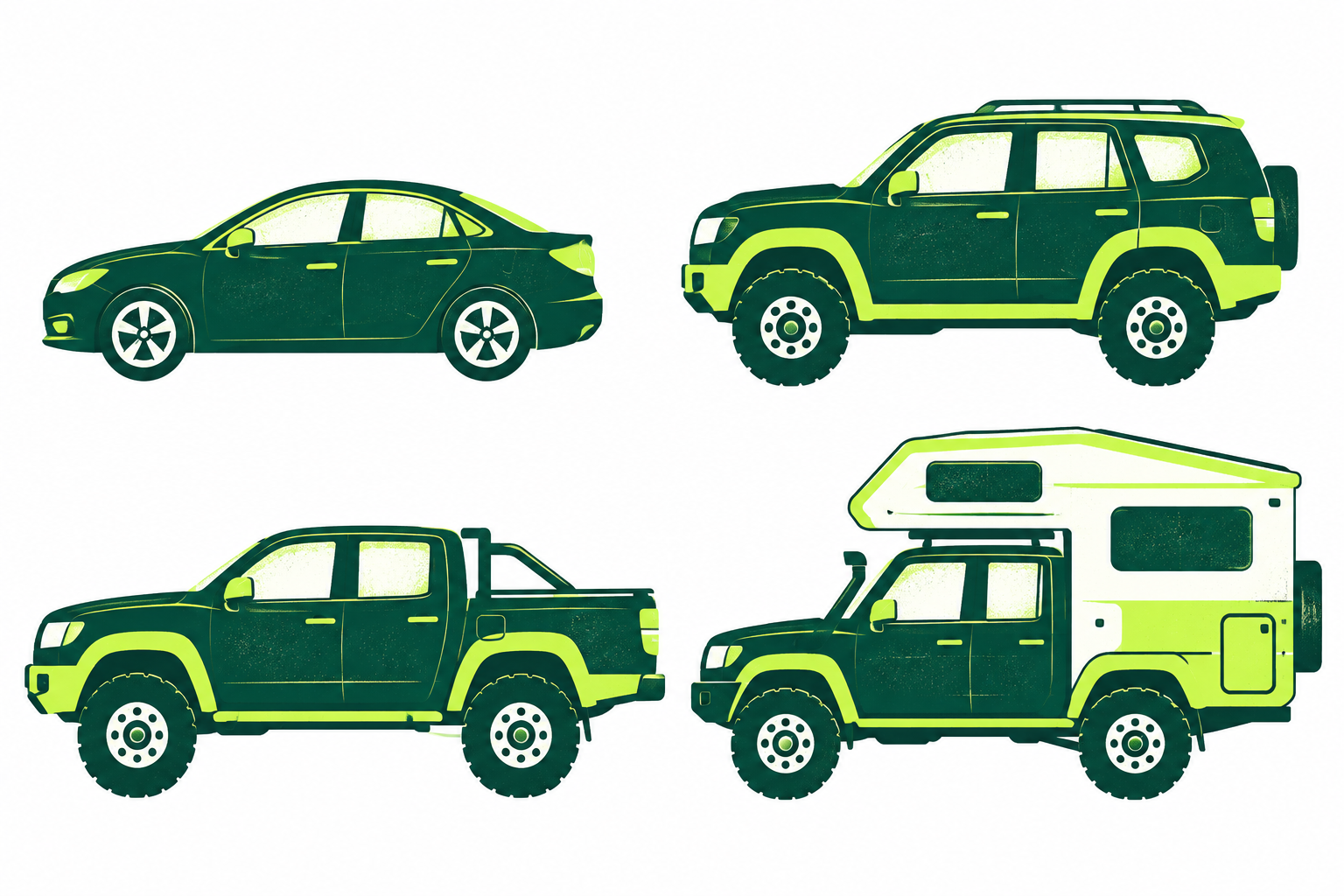
Think of the choice this way
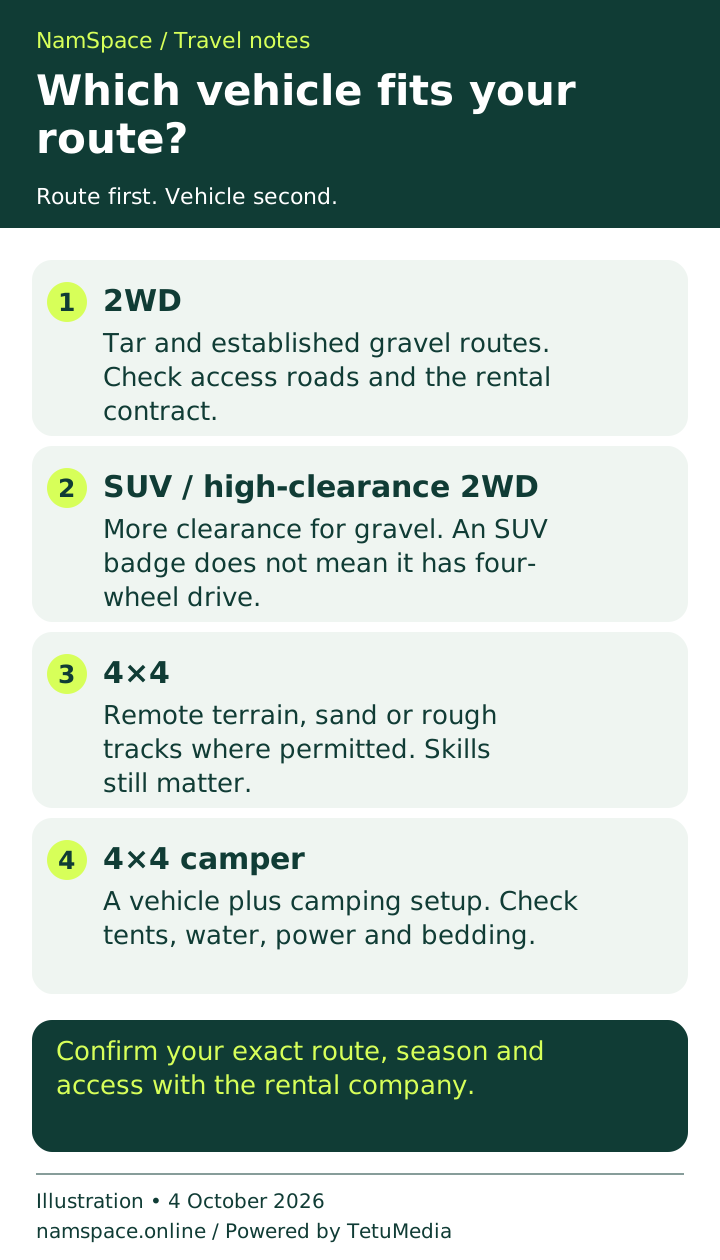
Image credit & rights
Illustration: NamSpace. Powered by TetuMedia.
2WD
Good when your route stays mainly on tar and established gravel tourism roads and you are sleeping in hotels, guesthouses or lodges.
Higher-clearance 2WD / SUV
A useful middle ground for travellers who want more clearance and comfort on gravel without paying for a full 4x4 they do not intend to use off the main network.
4x4
Better for remote routes, deeper sand, rough tracks, more adventurous camping itineraries and destinations where the route itself demands more capability.
4x4 camper
Makes sense when the vehicle is also your accommodation and equipment system.
A 4x4 is not permission to drive anywhere you like.
Namibia Tourism Board explicitly advises travellers not to leave established routes and attempt serious off-road driving on their own, and Namibia's park rules prohibit leaving designated roads in protected areas unless specifically authorised.
The landscape can hold tyre tracks for years.
A 4x4 also does not make you an experienced 4x4 driver
This sounds obvious until somebody gets stuck in deep sand.
If you hire a 4x4, ask the rental company to show you:
- when and how to use 4H and 4L;
- how the tyre-changing equipment works;
- where recovery points are located;
- whether and when tyre pressures should be adjusted for specific terrain;
- how the jack works on that exact vehicle; and
- what the rental company wants you to do if you become stuck or damage a tyre.
Do this before leaving Windhoek.
Not when the vehicle is already leaning into sand 300 km away.
Which licence can a visitor use?
Namibian law recognises qualifying foreign driving licences and international driving permits.
For a foreign licence, the regulations state that it should be valid in the country of issue and either:
- be issued in English; or
- be accompanied by an English certificate of authenticity/validity from a competent authority or a sworn English translation.
It must also contain, or have attached, the driver's photograph and signature.
An international driving permit recognised under the applicable conventions can also be used subject to its validity and conditions.
Your rental company can impose additional documentation rules, age limits or licence-holding periods, so check its requirements before paying for the vehicle.
Fuel: do not wait for the warning light to plan your next stop
Namibia has fuel stations throughout its larger towns and along major routes.
That does not mean the next fuel station is always nearby.
Distances can be long, particularly once you move into remote western, north-eastern or desert routes.
Namibia Tourism Board specifically advises self-drivers travelling in the north-east to carry extra fuel and provisions where appropriate because distances can be long and arduous.
A simple habit removes a lot of unnecessary stress:
When you reach a meaningful town or reliable fuel stop, consider filling up even if the tank is not close to empty.
Do not build a remote itinerary around the assumption that every fuel station shown online will definitely be open, have power and have the fuel you need at the exact time you arrive.
For remote routes, confirm the next reliable fuel point locally before leaving.
Carry water separately from your vehicle's needs
Namibia Tourism Board advises self-drive travellers to keep plenty of water in the vehicle.
That should mean drinking water for the people in the car, not merely coolant and emergency vehicle supplies.
A breakdown is inconvenient anywhere.
A breakdown in a sparsely populated part of Namibia on a hot day changes the calculation.
Carry enough water that a delay does not immediately become an emergency.
Your spare tyre matters more than your playlist
For a normal city rental, many people never even look at the spare wheel.
For a Namibian self-drive, look at it before leaving.
The Tourism Board's self-drive planning guide recommends carrying a spare wheel — preferably two for remote travel — together with items such as an air compressor or pump, tyre gauge, battery leads, tow rope, shovel and a basic toolkit.
Not every traveller needs to buy all of that.
If you are hiring a vehicle, the important question is:
What does this vehicle already carry, and what does my route require?
Before departure, physically check:
- the spare tyre;
- jack;
- wheel spanner;
- warning triangle;
- tyre-repair equipment if supplied;
- compressor if supplied;
- emergency contact information; and
- where the rental company's roadside-assistance instructions are stored.
A spare tyre that exists but is flat is not a spare tyre.
Avoid building your itinerary around driving after dark
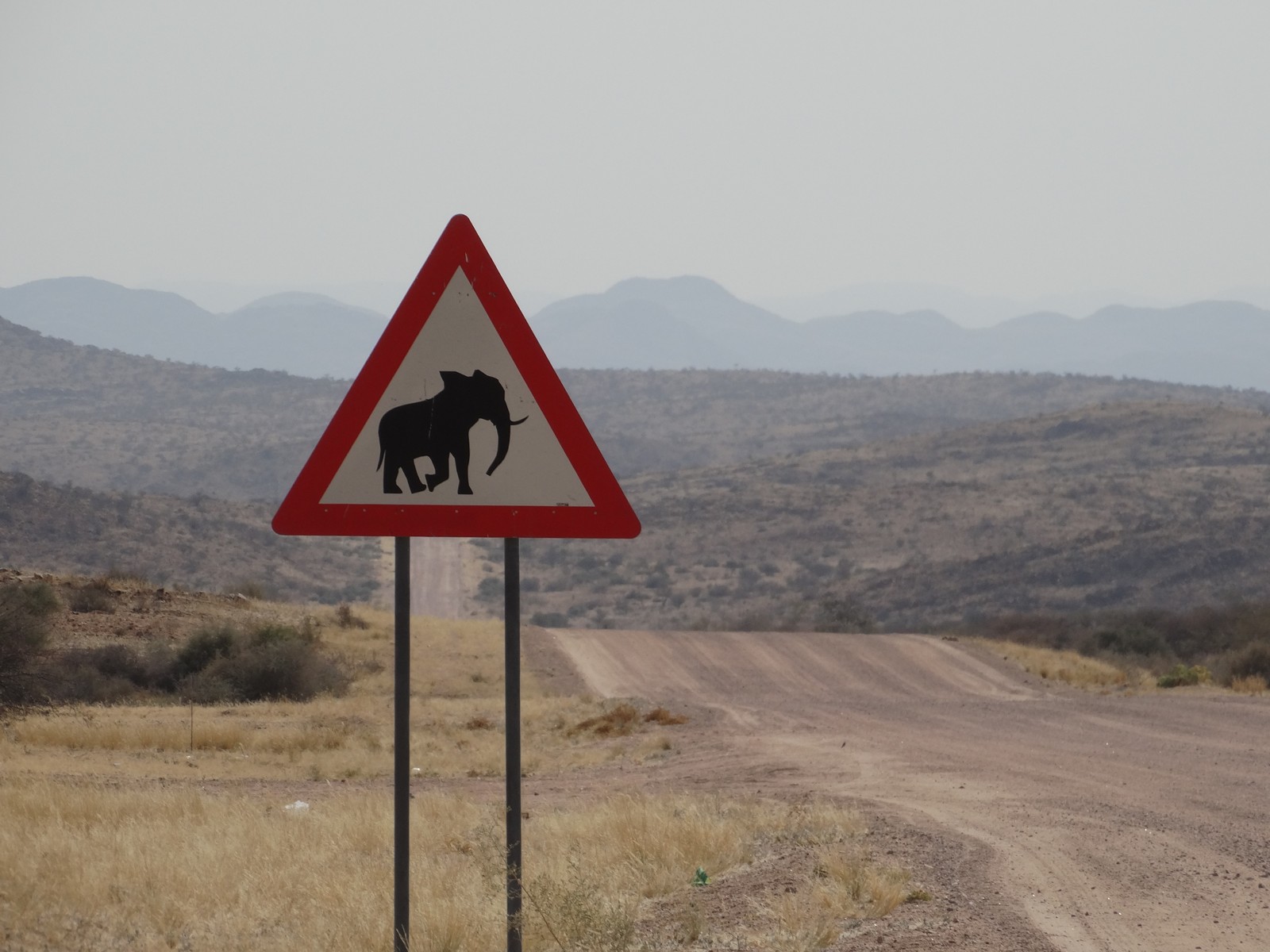
Image credit & rights
Roadsign Namibia.jpg — Benoît Vicart, via Wikimedia Commons. CC0 1.0. Source: https://commons.wikimedia.org/wiki/File:Roadsign_Namibia.jpg. Licence: https://creativecommons.org/publicdomain/zero/1.0/. Resized for web; no scene content changed.

Namibia's Roads Authority road-safety guidance advises motorists to avoid driving after dark where possible.
For tourists, that makes even more sense.
You are dealing with unfamiliar roads, limited lighting outside towns, livestock and wildlife, and distances that can make fatigue more dangerous than it feels.
Plan to reach your overnight stop with daylight left.
That gives you margin for:
- a puncture;
- a slow gravel section;
- a photo stop;
- roadworks;
- getting temporarily lost; or
- simply deciding the drive is more beautiful than expected and stopping to enjoy it.
If you are constantly racing sunset to reach the lodge, the itinerary is too tight.
Use this question instead of trusting the map estimate
Do not ask only:
Can I drive this in one day?
Ask:
Will I still enjoy the day after driving it?
A 450 km day on tar is not the same trip as a 450 km day involving gravel, mountain passes and scenic stops.
And a route that takes six hours on paper may become eight once you actually travel like a visitor rather than a delivery driver.
Namibia rewards time.
Give it some.
What about cellphone signal and navigation?
Cellphone coverage is good across many populated areas and major travel corridors, but do not assume continuous data everywhere you travel.
Download offline maps before leaving a major town.
Save your accommodation's phone number.
Take a screenshot of written directions when a lodge sends them.
And if your next property is genuinely remote, ask them whether the final approach has any turn-offs that mapping apps commonly get wrong.
A map app is a tool.
Local instructions are still useful.
Crossing into Namibia with a car — or taking your rental out of Namibia
If you enter Namibia in a foreign-registered vehicle, cross-border road charges apply and a certificate is issued on entry.
If you are crossing a border with a hired car, Namibia Tourism Board advises travellers to tell the rental company in advance because the company needs to provide the appropriate paperwork.
The same principle applies if you hire in Namibia and intend to drive into Botswana, South Africa, Zambia or elsewhere:
Do not assume your rental contract automatically allows it.
Tell the company your entire planned route before accepting the vehicle.
This is particularly important for the traveller building a larger Southern African road trip around Etosha, Kavango and Zambezi.
National parks have their own rules
The national speed limit is not the only rule that matters once you enter a park.
Follow the speed signs and park regulations displayed there.
MEFT states that visitors to Namibia's national parks may not leave indicated roads, and the Ministry has repeatedly warned visitors about speeding and other violations of park rules.
This is not only about avoiding a fine.
You are driving through wildlife habitat.
Stop treating the road like a road whenever an animal is involved.
Give it space.
Do not block it for photographs.
Do not leave the designated route because somebody told you there was a lion behind a bush.
Remote Namibia is different from the classic route
A first-time route such as:
Windhoek → Sossusvlei → Swakopmund → Damaraland → Etosha → Windhoek
is very different from deliberately exploring remote parts of Kunene, Khaudum, Kaokoland or less-travelled north-eastern tracks.
For example, MEFT says Khaudum National Park requires visitors to travel in a convoy of at least two vehicles, with only one vehicle in the convoy towing a trailer.
That is not the sort of condition you discover after arriving at the gate.
Remote itineraries deserve route-specific research.
A practical vehicle checklist before leaving Windhoek
Before you drive out of town, make sure you know:
- Which side the fuel cap is on.
- What fuel the vehicle takes.
- How to change a tyre.
- Where the spare wheel and tools are.
- What tyre pressure the rental company recommends for normal road use.
- How 4H/4L works, if applicable.
- The rental company's emergency number.
- Whether the contract allows every road on your itinerary.
- Whether cross-border travel is authorised, if relevant.
- How much fuel and water you need before the next remote section.
Ten minutes doing this in a parking lot can save hours later.
Find the right vehicle for your Namibia route
Compare vehicles and pickup arrangements through NamSpace’s car-hire directory.
What are you looking for?
2WD — classic routes and town-to-town travel
SUV / high clearance — extra comfort and clearance on gravel
4x4 — remote routes, sand and more demanding tracks
4x4 camper — vehicle + rooftop tent/camping equipment
Airport pickup — collect the vehicle after landing
Find car & 4x4 hire in Namibia
Public-source businesses are labelled Directory listings. A directory entry is not a claim of NamSpace partnership or verification.
Paying for featured placement must never be presented as verification.
Six mistakes that cause avoidable problems
1. Planning distances as if every road is tar
It is not.
Build gravel time into the trip.
2. Driving the legal maximum because the road looks empty
The road surface has more influence on safety than how many cars you can see.
3. Hiring the cheapest vehicle before choosing the route
Choose the itinerary first.
Then choose the vehicle that fits it.
4. Ignoring the spare wheel until you need it
Check the equipment before departure.
5. Planning to arrive after dark
Use daylight as part of your itinerary budget.
6. Treating a 4x4 as permission to go off-road
Follow designated routes, environmental restrictions and park rules.
So, should you self-drive Namibia?
For many travellers: yes.
Self-driving gives you exactly the kind of freedom Namibia rewards.
You can stop when the landscape changes.
Spend longer at a waterhole.
Stay another night at the coast.
Leave early because the desert morning is too good to waste.
The trick is not to treat the car as something that simply moves you between the interesting parts.
In Namibia, the road is one of the interesting parts.
Choose the right vehicle.
Slow down on gravel.
Leave room in the day.
Keep fuel and water in mind.
And build a route you still have enough energy to enjoy when you arrive.
Continue planning
Find Car & 4x4 Hire in Namibia
The Practical 14-Day Namibia Road Trip
Best Time to Visit Namibia: A Month-by-Month Guide
Sources and travel updates
Last checked 4 October 2026 against:
- Namibia Tourism Board — Transportation: https://visitnamibia.com.na/transportation/
- Namibia Tourism Board — 4x4 Off-Road: https://visitnamibia.com.na/4x4-off-road-2/
- Namibia Tourism Board — Self-Drive Planning Guide: https://visitnamibia.com.na/wp-content/uploads/2022/03/Self-drive.pdf
- Namibia Tourism Board — Border Posts & Point of Entry: https://visitnamibia.com.na/border-posts-point-of-entry/
- Namibia Tourism Board — Health / portable water guidance: https://visitnamibia.com.na/health-copy/
- Roads Authority Namibia — current road-network information: https://www.ra.org.na/
- NamibLII — Road Traffic and Transport Act 22 of 1999 and Road Traffic and Transport Regulations, 2001
- Ministry of Environment, Forestry and Tourism — park permit/rule guidance: https://www.meft.gov.na/
Road conditions, construction, park access and rental-company restrictions can change. Travellers should confirm their exact route, vehicle contract and current road conditions before departure.