
Namibia travel · NamSpace
Namibia on a Budget: Where to Save, Where Not to Cut Corners and How to Plan Your Spend
Plan the full cost of your Namibia trip, compare complete quotes and find savings in the route, stays and activities that fit your priorities.
Image credit & rights
AI-generated editorial illustration for NamSpace using OpenAI image generation. Powered by TetuMedia. Abstract coins, not real currency; no actual prices or product endorsements.
Last checked: 4 October 2026
The cheapest room is not always the cheapest stop.
If it puts you far from the place you came to see, you can give back the saving in fuel, transfers and time. The same is true of a cheap rental quote that leaves out equipment you need, or a packed itinerary that adds driving days without giving you much time anywhere.
A good Namibia budget starts with the shape of the trip. Choose a manageable route, decide how you want to travel and sleep, then compare complete costs. A collection of low headline prices does not necessarily add up to an affordable holiday.
This guide helps you build that budget. It does not promise one daily amount that works for every traveller. Your dates, group size, vehicle, accommodation and activities all change the answer.
Start with three decisions, not a daily spending target
Before comparing prices, answer these questions:
- What are the two or three experiences you most want? Build around them instead of trying to cover the whole country.
- How will you move between them? Self-drive, organised transport and a guided itinerary have different cost structures.
- How do you want to sleep? Camping, guesthouses, self-catering and lodges need different comparisons.
Then count the actual travel days and nights. A ten-night trip can require eleven days of vehicle hire. Arrival and departure arrangements may add transfers, accommodation or meals that are easy to overlook.
Use our practical 14-day road trip as a route-planning starting point, then shorten or adapt it to your priorities. More destinations are not automatically better value.
1. Build the budget in five parts
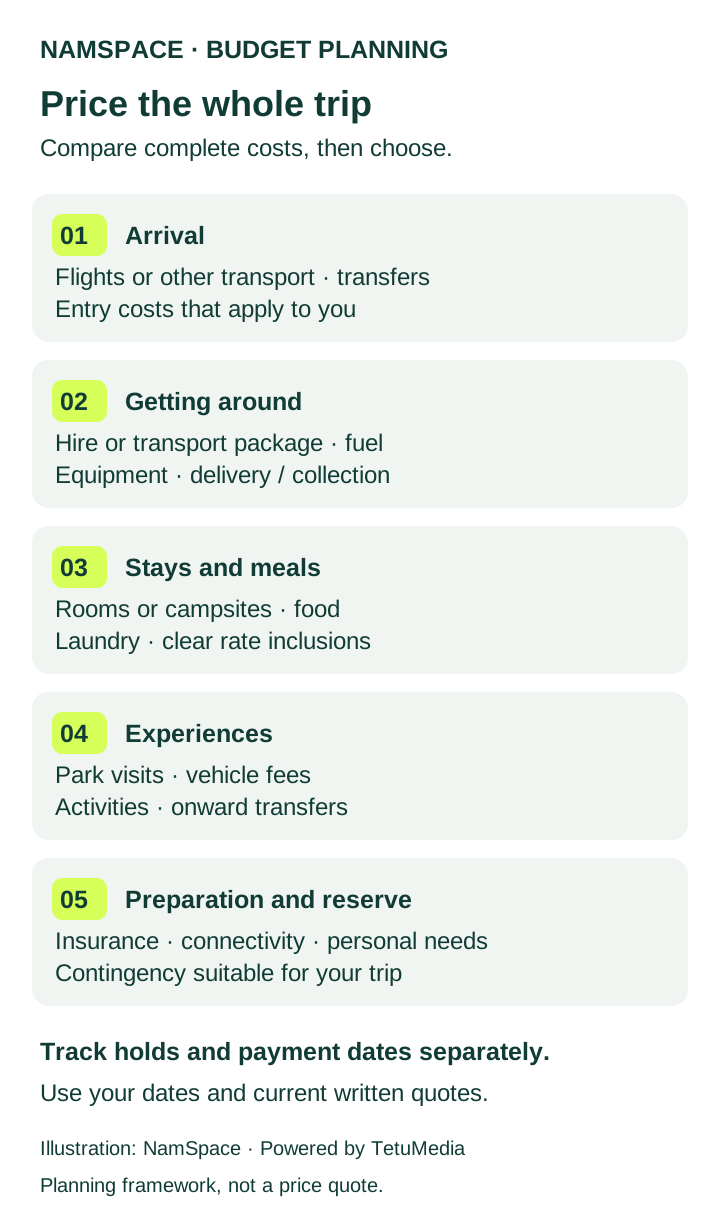
Image credit & rights
Original NamSpace explanatory illustration. Powered by TetuMedia. Planning framework, not a price quote.
| Budget part | What to include | What to check |
|---|---|---|
| Getting there | Flights or other arrival transport; airport transfers; entry costs that apply to you | What is included in each booking and whether connections add an overnight stay |
| Getting around | Vehicle hire or transport package; fuel; equipment; delivery or collection charges | Hire-day count, permitted route, inclusions and liability terms |
| Sleeping and eating | Accommodation, meals, groceries and laundry | Per-person vs per-room rates; meal plans; kitchen facilities |
| Experiences | Park entry, vehicle fees, guided activities and transfers | What your accommodation or activity booking includes |
| Preparation and reserve | Insurance, connectivity, personal needs and a contingency allowance | Costs outside the holiday itself and access to emergency funds |
Keep refundable deposits or card holds in a separate line. They can affect the money or credit you need available even when they are not ultimately spent. Also check when each payment falls due; a trip can be affordable in total but difficult to pay for on the required schedule.
2. Save distance before you cut comfort
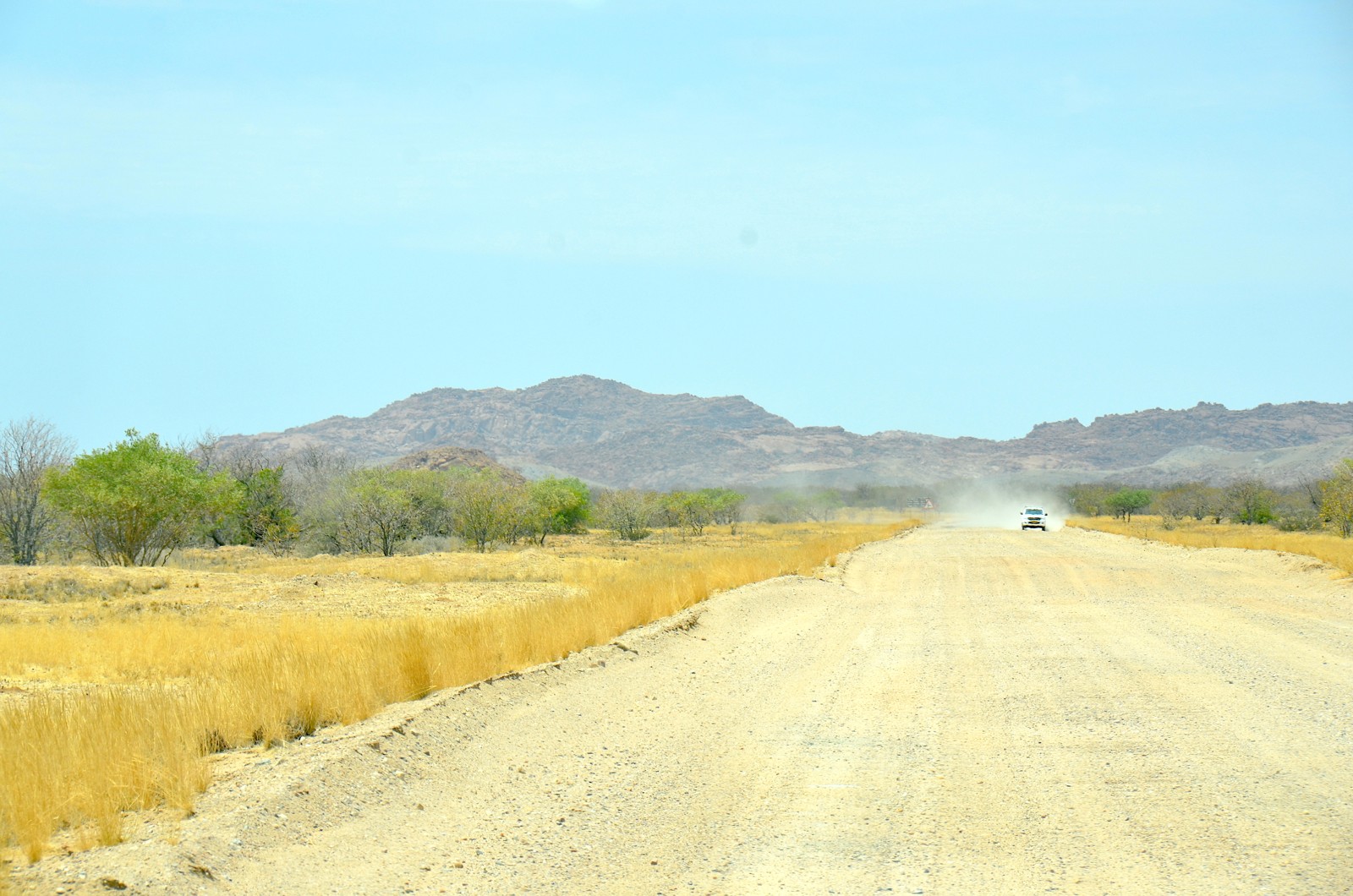
Image credit & rights
Gravel road, Namibia.jpg — Olga Ernst, via Wikimedia Commons. CC BY-SA 4.0. Resized for web; no scene content changed. Adapted image retains CC BY-SA 4.0.

Compare the cost of a route, not just its individual nights. Extra distance uses fuel and can keep a vehicle on hire for longer. A rushed route may also leave you paying for a destination you barely experience.
The Namibia Tourism Board's transport guidance stresses allowing adequate time for driving and stops. Use that principle when budgeting: a realistic route is easier to cost than an ambitious one you have to rearrange on the road.
Consider fewer bases and more time at each. Combine nearby activities when the travel arrangements make sense, and compare arrival times before booking the next night.
For a desert stop, check the property's actual route to Sesriem and the arrangements for the final part of the excursion. “Near Sossusvlei” does not tell you your complete transport cost. Our Sossusvlei and Deadvlei guide explains the questions to ask.
3. Compare the full vehicle quote
The daily rental price is only one part of the decision. Ask for a written quote covering your dates and intended route, then compare:
- the vehicle and equipment supplied;
- collection, return and any one-way arrangements;
- permitted mileage and relevant extra charges;
- insurance terms, excess and exclusions;
- the deposit or card hold;
- additional drivers and applicable age requirements;
- tyres, spare-wheel arrangements and roadside assistance; and
- any border permissions you need.
Do not assume a lower-priced vehicle is suitable for every route. Equally, do not choose a more expensive camping-equipped vehicle simply because it looks like the standard Namibia holiday. Match the vehicle to the route and the way you actually want to travel.
If you are considering a camper, include campsite charges and confirm the equipment inventory. Compare that combined cost with an appropriate vehicle plus rooms. Camping can be good value, but it is not a saving if you dislike it or have to buy missing equipment along the way.
Read our driving guide and use the car-hire directory to make enquiries. Directory inclusion does not make a supplier's quote complete or establish a partnership.
4. Look beyond the cheapest accommodation rate
Check whether a rate is per room, per person sharing, per person single or per campsite. Confirm the dates, number of guests, applicable category and included meals before comparing it with another option.
Namibia Wildlife Resorts publishes rates by season and accommodation category. Its Sesriem and Okaukuejo pages are useful examples of why you should read the relevant row and date column, then confirm the total through a booking enquiry.
For each stay, ask what the booking includes: meals, bedding, towels, cooking facilities and any booked activities. Check cancellation conditions too. A lower non-refundable price may be poor value when your plans are still uncertain.
Self-catering can help you control meal spending if you will actually use the kitchen. A room with breakfast included may suit you better if mornings start early. A more expensive location can still be worthwhile if it simplifies an important activity.
Our where-to-stay guide compares the major choices. For the coast, use Swakopmund vs Walvis Bay to choose a base around your plans rather than the room price alone.
5. Make food and activities deliberate choices
Choose a realistic mix of groceries, included meals and restaurant meals. Ask what self-catering facilities are available before buying food that needs storage or cooking equipment you do not have.
You can reduce spending by selecting a few activities that matter to you and leaving other days less programmed. A holiday does not need a paid excursion every morning and afternoon.
Before paying for an activity, confirm the duration, transport arrangements, equipment, group size, cancellation terms and any costs payable separately. Compare equivalent experiences rather than two descriptions with different inclusions.
For parks, separate accommodation from entry and vehicle charges. NWR links park entrance and conservation fees separately from its accommodation information. Verify current rules and the applicable visitor category; do not assume a campsite or room booking includes every park-related cost.
Use the Etosha first-timer guide to decide how many nights and which part of the park fit your priorities before pricing stays.
6. A worked example: learn the method, then replace every number
The following figures are invented calculation inputs, not current rental, accommodation, fuel or activity prices. They are not a recommended minimum budget or a quote. The example shows how to add a trip up for two adults sharing a vehicle and accommodation over eleven days and ten nights. International arrival costs are excluded.
| Item | Illustrative calculation | Trip total |
|---|---|---|
| Vehicle | 11 days × N$1,200 | N$13,200 |
| Accommodation | 10 nights × N$900 per room | N$9,000 |
| Fuel | 2,000 km × 10 L/100 km × N$22/L | N$4,400 |
| Food | 11 days × N$450 for both travellers | N$4,950 |
| Park visits, transfers and activities | Assumed combined allowance | N$3,000 |
| Subtotal | N$34,550 | |
| Illustrative contingency | 10% of subtotal | N$3,455 |
| Illustrative trip total | N$38,005 |
Shared equally, that is N$19,002.50 per person, before flights or other arrival costs, applicable entry costs, insurance, connectivity, equipment purchases and other personal expenses. It does not include refundable holds. The example's contingency is an arithmetic choice, not a guarantee that it covers a disruption or insurance excess.
Replace each assumption with your own dates, written quotes, route distance, vehicle's expected consumption and current fuel price. Driving conditions, detours and vehicle load can affect consumption, so do not treat a fuel calculation as an exact bill.
Notice what happens if you remove one destination: distance, fuel, activities and accommodation can all change. Notice what happens if you travel alone: you may carry much more of the vehicle and room cost yourself. This is why a daily figure borrowed from another traveller can be misleading.
7. Where I would protect the budget
I would look for savings in route complexity, duplicate activities, unnecessary equipment, accommodation features I will not use and meals I have not planned.
I would protect the things that make the trip workable: a suitable vehicle, clear assistance arrangements, realistic driving time, necessary personal health preparation, adequate drinking-water arrangements and insurance that fits the trip and activities.
Read insurance and rental conditions, including exclusions and excess, before deciding a cheaper option gives you the same protection. Ask the provider when a term is unclear. Keep those decisions separate from cosmetic upgrades such as a room view or a larger camera lens.
If the complete route is over budget, shorten or simplify it before removing essentials. A smaller trip you can enjoy is better than a larger one that keeps creating expenses you did not plan for.
8. Keep the money plan practical
Build the working budget in Namibian dollars, then convert it for your own planning using a current rate and your payment provider's charges. The Bank of Namibia maintains one-to-one parity between the Namibian dollar and the South African rand; that does not tell you your bank's conversion cost from another currency.
Check card acceptance with suppliers, ATM access along the route and how much cash you will need for specific payments. Keep more than one payment option and store them sensibly. Ask about payment links, invoices and booking references through the supplier's verified contact channel before transferring money.
Record what is already paid, what remains due and which deposits may be refundable. Save booking confirmations and cancellation deadlines where you can access them without relying on a connection.
Your budget is ready when the unanswered lines are small
Before booking the final pieces, check that you have:
- a route with realistic travel days;
- written transport and accommodation totals with clear inclusions;
- food and activity allowances that match your plans;
- entry, insurance and personal preparation costs recorded;
- a separate list of holds and deposits;
- a reserve you understand; and
- a payment schedule showing what is due and when.
There will always be choices you make on the trip. The aim is to leave room for those choices without discovering that a major part of the holiday was missing from the budget.
Use our Namibia Travel Guide to check the wider plan, and What to Pack for Namibia to avoid buying equipment you do not need.
Sources and updates
Checked on 4 October 2026. Planning suggestions are NamSpace editorial guidance. The worked example is wholly hypothetical; no supplier quote or live price is represented by its inputs.
- Namibia Tourism Board: transportation — allowing time for driving and stops.
- NWR: Sesriem Campsite and Okaukuejo Resort — dated accommodation categories and seasonal rate presentation; confirm individual bookings.
- NWR: park entrance and conservation fees — separate park-fee reference; check current category and terms.
- Bank of Namibia: monetary policy — Namibia dollar/South African rand parity.